
A variable-speed pump gives you more choices than “on” and “off.” That flexibility is useful only when the settings make sense for the pool connected to it.
If you recently upgraded your pump, inherited unfamiliar controls with a new home, or changed your pool equipment, it is worth understanding what the schedule is meant to accomplish.
The question is not simply how low the pump can run. It is whether the complete system gets the circulation it needs without unnecessary energy use.
Different jobs can need different settings
Filtration, cleaning, water features, and connected equipment do not necessarily require the same flow. A schedule can account for those differences instead of running one setting throughout the day.
The U.S. Department of Energy’s Building America guidance emphasizes matching pump operation to the required task. That is the purpose of programming: identify what the pool needs, then establish suitable operation for those needs.
Think of the schedule as a list of jobs. Which periods support ordinary filtration? When does other equipment need to operate? What changes when the pool or spa is being used?
Speed and flow are different measurements

Motor speed is commonly expressed in revolutions per minute, or RPM. Flow describes how much water moves through the system, often in gallons per minute, or GPM.
The same RPM does not guarantee the same flow in two different pools. Plumbing and equipment affect resistance, so a setting copied from a neighbor’s pump is not a substitute for checking your own system.
Some pumps offer both speed-based and flow-based programs. Pentair’s IntelliFlo3 VSF documentation, for example, describes separate speed and flow settings and operating limits. Those features are model-specific; not every variable-speed pump measures or manages flow in the same way.
Salt systems need attention when schedules change
If your pool uses a salt chlorine generator, changing pump operation can also affect chlorine production.
Hayward’s salt-cell instructions explain that chlorine production depends on daily filter-pump operating time and that low-speed operation must still provide adequate flow through the cell. A longer or shorter pump schedule may therefore require the chlorination settings to be reviewed as well.
That does not mean making a blind adjustment to the chlorine output. The equipment instructions and water-test results should guide the process. A low-flow warning is a reason to investigate, not a prompt to disable the protection.
Connected equipment sets practical limits
Heaters and some cleaners have their own flow requirements. Water features may need a different operating point from routine circulation. These needs can limit how low a pump should run during particular activities.
Review the manuals for the equipment actually installed. A generic internet schedule cannot tell you which combination of settings meets all those requirements in your pool.
For a homeowner, a useful question is: “How was this schedule checked with my other equipment operating?” That makes the conversation about system performance rather than a single number on a display.
Read this graphic as text
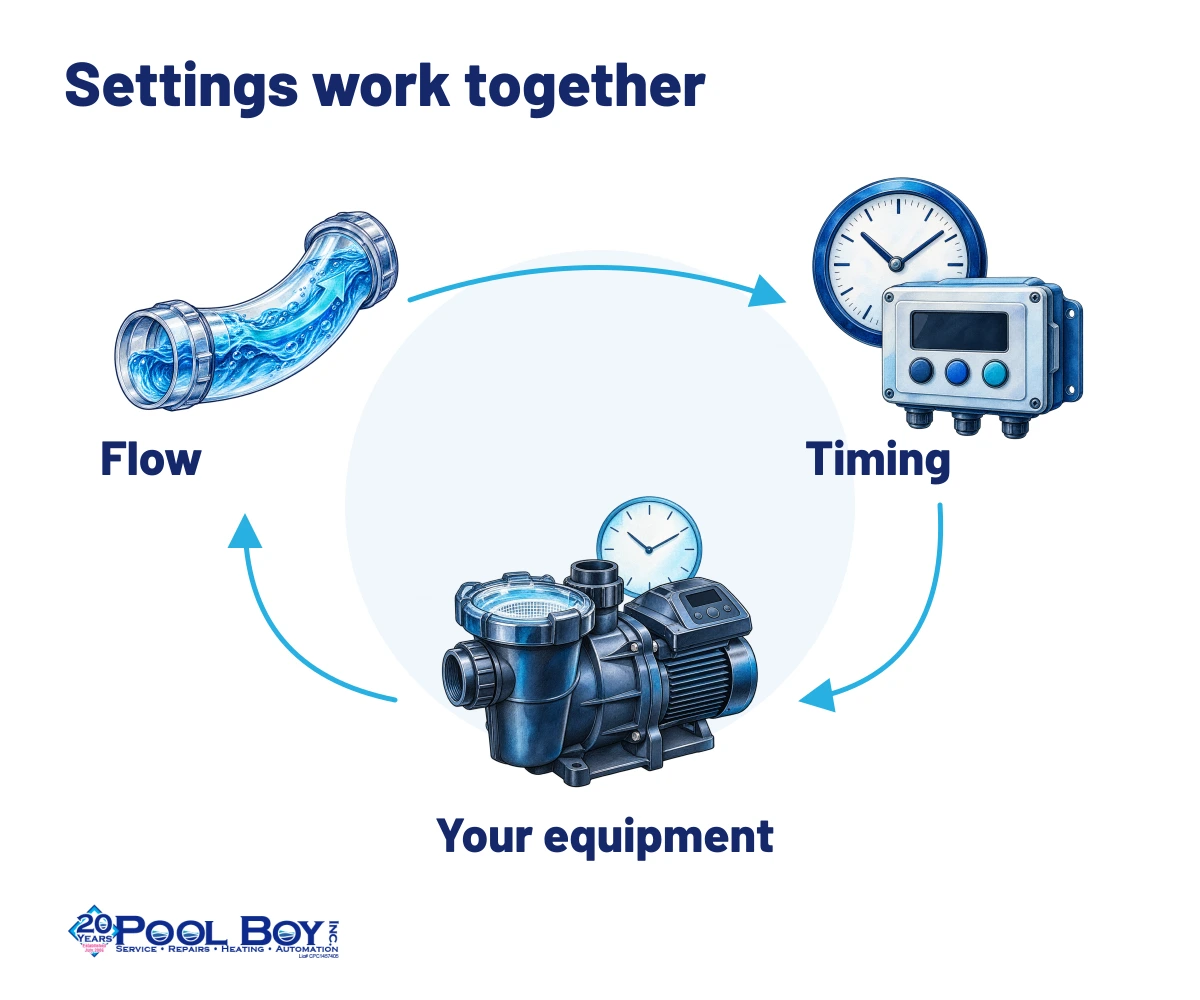
Settings work together: Flow · Timing · Your equipment
Water flow, a clock with controls, and a circulation pump show that programming depends on flow needs, timing, and connected equipment. Arrows indicate coordination, not physical plumbing. No universal RPM or runtime is specified.
Keep the filter and controls in the conversation
A schedule is only one part of efficient operation. Baskets and filters need appropriate maintenance so water can move through the system as intended. ENERGY STAR includes preventive maintenance in its pool-pump efficiency guidance.
Do not assume every variable-speed pump automatically increases its speed as a filter loads. Behavior depends on the model and control mode. Follow the filter manufacturer’s cleaning instructions, and have a change in circulation evaluated rather than repeatedly raising pump speed to hide it.
Controls deserve a check, too. On supported equipment, a repeating schedule is different from a manually started or timed program. Understanding which mode is active can help explain why a pump does not behave as expected.
When should the settings be reviewed?
Consider a review after a pump replacement, a control reset, or the addition of a salt system, heater, cleaner, or automation equipment. It can also help when you cannot explain the current schedule or the pool’s operation has changed.
For seasonal homeowners in Charlotte County, keep a clear record of what each program does and who to contact if an alert appears. Compatible pool automation can make controls easier to access, but remote access does not replace regular pool care.
Frequently asked questions
What is the best RPM for my pool pump?
There is no universal setting. It depends on the pump, plumbing, equipment, and task. Use a schedule established for your system rather than copying another pool’s numbers.
Should I simply reduce the number of operating hours?
Not without considering circulation and sanitation. Runtime, operating power, and connected equipment all matter. A shorter schedule is not automatically a better schedule.
Can I leave the factory settings alone?
Factory settings do not establish that the pump has been optimized for your pool. Ask the installer which programs were configured and what each is intended to do.
Make the settings work for your pool
Pool Boy’s energy-efficient pump service includes installation and programming suited to the system. If your settings are unclear or you are planning an upgrade, start with a conversation about your existing equipment.
Call 941-255-1900 or request service online for your Punta Gorda, Port Charlotte, or Charlotte County pool.