
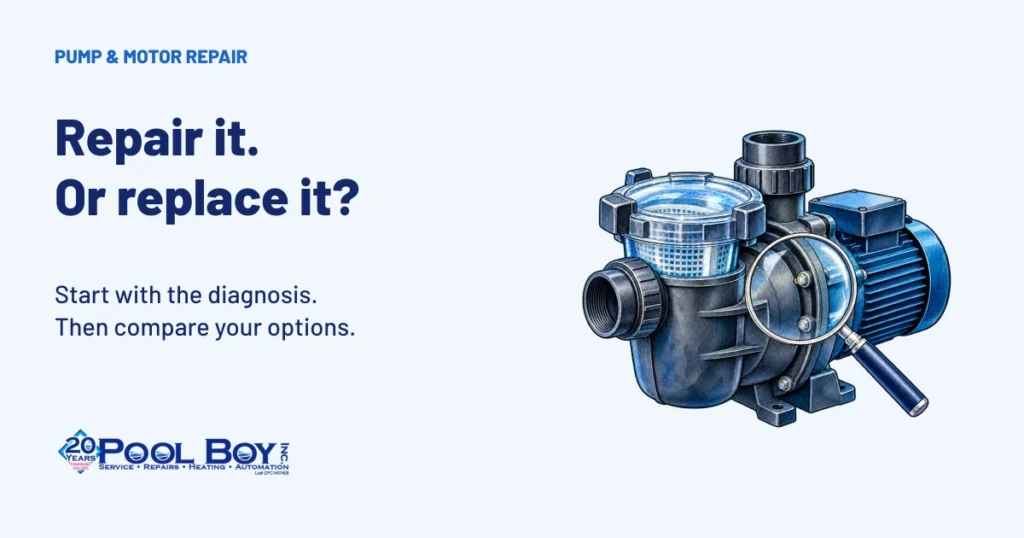
Your pool pump starts making a new noise. You notice water around the equipment. Or the system seems fine one day and struggles the next.
The immediate question is usually the same: can this be repaired, or is it time for a new pump?
For homeowners in Punta Gorda and Port Charlotte, the best starting point is a diagnosis. The symptom tells you something needs attention; it does not tell you how much equipment needs replacing.
Start with what changed
Pool Boy’s pump repair guidance identifies several reasons to arrange service: unusual sounds, visible leaks, weak circulation, loss of prime, trouble starting, and unexpected shutdowns.
Make a note of what you observed and when it happens. Does the noise occur only at startup? Did the issue begin after another piece of equipment was adjusted? Is there a message on the display?
A photo of the equipment label and a short recording of an unusual sound can help you explain the problem. There is no need to take anything apart to gather that information.
A symptom is not a diagnosis
Water near the pump could come from a seal, lid, fitting, or another connection. A circulation problem may involve equipment elsewhere in the system. Replacing the pump without finding the cause can leave the original problem unresolved.
Manufacturer troubleshooting documentation makes the same distinction. Pentair’s IntelliFlo3 installation guide considers issues such as air leaks, blockages, and system conditions when diagnosing performance problems. The exact checks depend on the installed equipment.
Electrical work and opening pressurized equipment belong with a qualified professional. Do not keep resetting a repeatedly tripping breaker or bypass a safety device to make the pump run.
When a repair deserves consideration
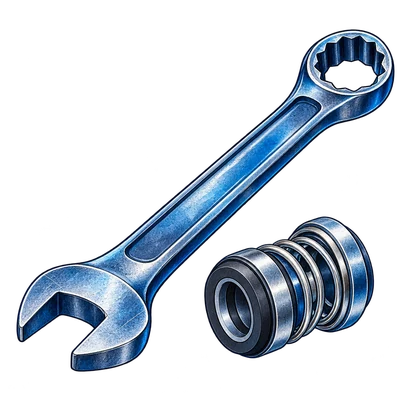
A repair can be a sensible choice when the fault is isolated, the remaining equipment is in serviceable condition, and the necessary compatible parts are available.
For example, repairing a leaking connection is a different decision from replacing an entire assembly. A motor issue also does not automatically mean every part of the pump has failed. Pool Boy evaluates the assembly before recommending whether a motor repair or a complete replacement makes more sense.
Ask what the proposed repair includes. Does it address the cause of the failure? Are there other concerns you should plan for? What coverage applies to the repaired parts and labor?
You should be able to understand what the money buys, not just receive a number beside the word “repair.”
When replacement becomes worth discussing
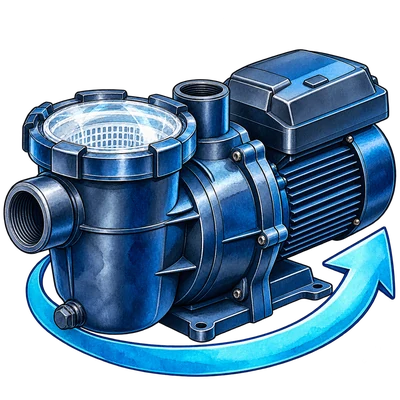
Replacement deserves a closer look when the pump has several significant problems, compatible parts are difficult to obtain, or repeated repairs have become a pattern.
It is also reasonable to compare an upgrade when a substantial repair is already on the table. A replacement may offer features your present setup lacks, but those benefits should be explained alongside the immediate repair need.
Age helps provide context; it should not be the entire argument. Ask why replacement is recommended for this particular pump and what would happen if you chose the repair instead.
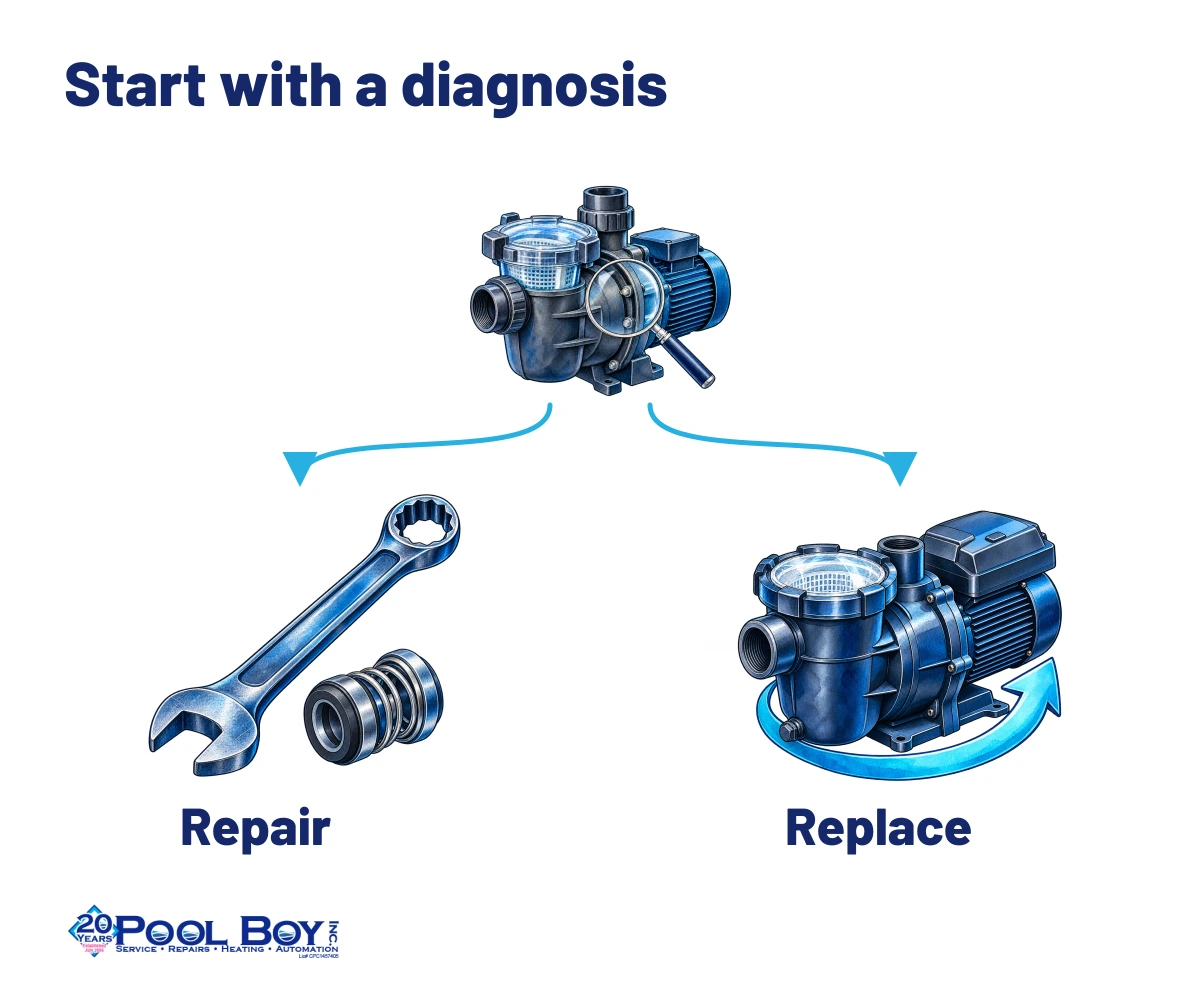
Read this graphic as text
Start with a diagnosis: Repair · Replace
A magnifying glass over a pump represents diagnosis. Two branches lead to repair parts and a replacement pump. The illustration presents options, not a symptom-based diagnostic rule.
Compare complete estimates
A repair quote and a replacement quote are only useful side by side when you know what each includes.
Ask for clarity on:
- The diagnosed problem and recommended work.
- Parts, labor, and any additional installation work.
- Compatibility with existing controls and equipment.
- Programming and owner instruction, where applicable.
- Warranty terms and any exclusions.
- Expected availability of the required equipment or parts.
If projected energy savings are part of the replacement recommendation, ask for the assumptions. The cost of a new pump should not be justified by a savings figure borrowed from a different pool.
Bring these questions to the conversation
“What failed?” and “What else did you find?” are useful starting points. Follow with “Would the repair leave me with a dependable system?” and “What practical benefit would replacement add?”
You do not need to become an equipment expert before asking for help. You need a clear explanation of the choices and enough information to decide which fits your situation.
Frequently asked questions
Can the motor be replaced without replacing the whole pump?
Sometimes. Compatibility and the condition of the housing, seals, and remaining components matter. Have the full assembly evaluated before choosing a motor-only solution.
Does a loud pump always need replacing?
No. A new or worsening noise warrants diagnosis, but the sound alone does not establish whether the solution is a repair, adjustment, or replacement.
Should I wait until the pump stops completely?
If you are seeing leaks, shutdowns, or a clear change in performance, arrange an evaluation. Waiting for total failure removes the opportunity to understand your options while the problem is developing.
Find out what your pump actually needs
Pool Boy’s pool pump and motor repair service starts with identifying the problem and explaining the options. If an upgrade is appropriate, you can also discuss energy-efficient pump installation.
Call 941-255-1900 or request service online. Tell us your location in Punta Gorda, Port Charlotte, or Charlotte County and what the pump is doing.