
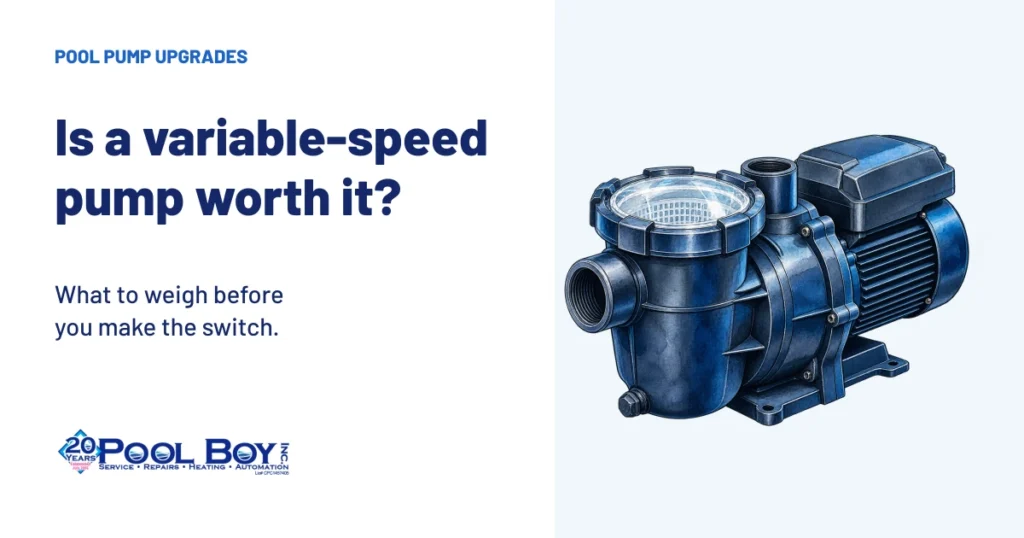
If your pool pump is loud enough to compete with a conversation on the lanai, an upgrade can sound appealing. But before replacing equipment that still runs, you probably want to know what you would actually gain.
A variable-speed pool pump can offer quieter operation and lower electricity use than an older single-speed setup. Whether it is worth the investment for your Punta Gorda or Port Charlotte home depends on the pump you have now, its condition, and how a replacement would be sized and programmed.
Here is what to consider before making that decision.
What changes when you switch to variable speed?
A single-speed pump runs at one motor speed whenever it is on. A variable-speed pump gives you a range of speeds, allowing operation to be adjusted for different pool functions.
Routine filtration and a water feature may need different amounts of flow. Running the same high setting for both can use more electricity than necessary. Variable speed gives the system room to match the job, rather than treating every operating hour the same.
ENERGY STAR identifies that ability to match pump speed to pool operation as an important energy-saving feature. It is also why the installation and setup deserve as much attention as the equipment label.
Will it lower your electric bill?

It may, particularly when replacing a single-speed pump that spends long periods operating at a higher output than the pool needs. But there is no honest dollar amount that applies to every backyard.
The useful comparison is daily energy use, measured in kilowatt-hours, under two schedules that both meet the pool’s needs. A pump running for more hours at lower power can use less electricity than one running for fewer hours at higher power. Hours alone do not tell the whole story.
For a simple, hypothetical example, equipment drawing 1 kilowatt for six hours uses 6 kilowatt-hours. Equipment drawing 0.4 kilowatts for ten hours uses 4 kilowatt-hours. At an assumed electricity rate of $0.15 per kilowatt-hour, those daily costs would be $0.90 and $0.60.
Those are arithmetic examples, not measured pump performance, a local utility rate, or recommended schedules. They also do not establish that both settings would provide enough circulation for your pool. A useful estimate needs your actual operating conditions and electricity charges.
The benefits go beyond electricity
Noise matters when the equipment sits near a patio, bedroom, or neighbor’s property. Lower-speed operation can make the pump less noticeable during everyday filtration. That does not mean it will be silent or equally quiet at every setting.
Controls can also be more flexible. Some models support app access or integration with compatible automation. Pentair’s IntelliFlo3 VSF, for example, offers app-based control. Features vary by model, so check what is included before making remote access part of the buying decision.
If you already have an automation system, ask whether the proposed pump can communicate with it and whether additional components would be needed.
Is now the right time to replace it?
Start with the problem you are trying to solve. Is the pump failing repeatedly? Is a significant repair coming up? Would you like less noise? Or are you adding equipment that changes how the pool needs to operate?
A working pump with a manageable repair deserves a different conversation from an unreliable unit with several worn components. Ask for the repair option and the replacement option, with the work included in each clearly explained.
Consider the full installed cost, available warranty coverage, anticipated operating pattern, and expected ownership plans. Be cautious of a payback promise that does not explain its assumptions.
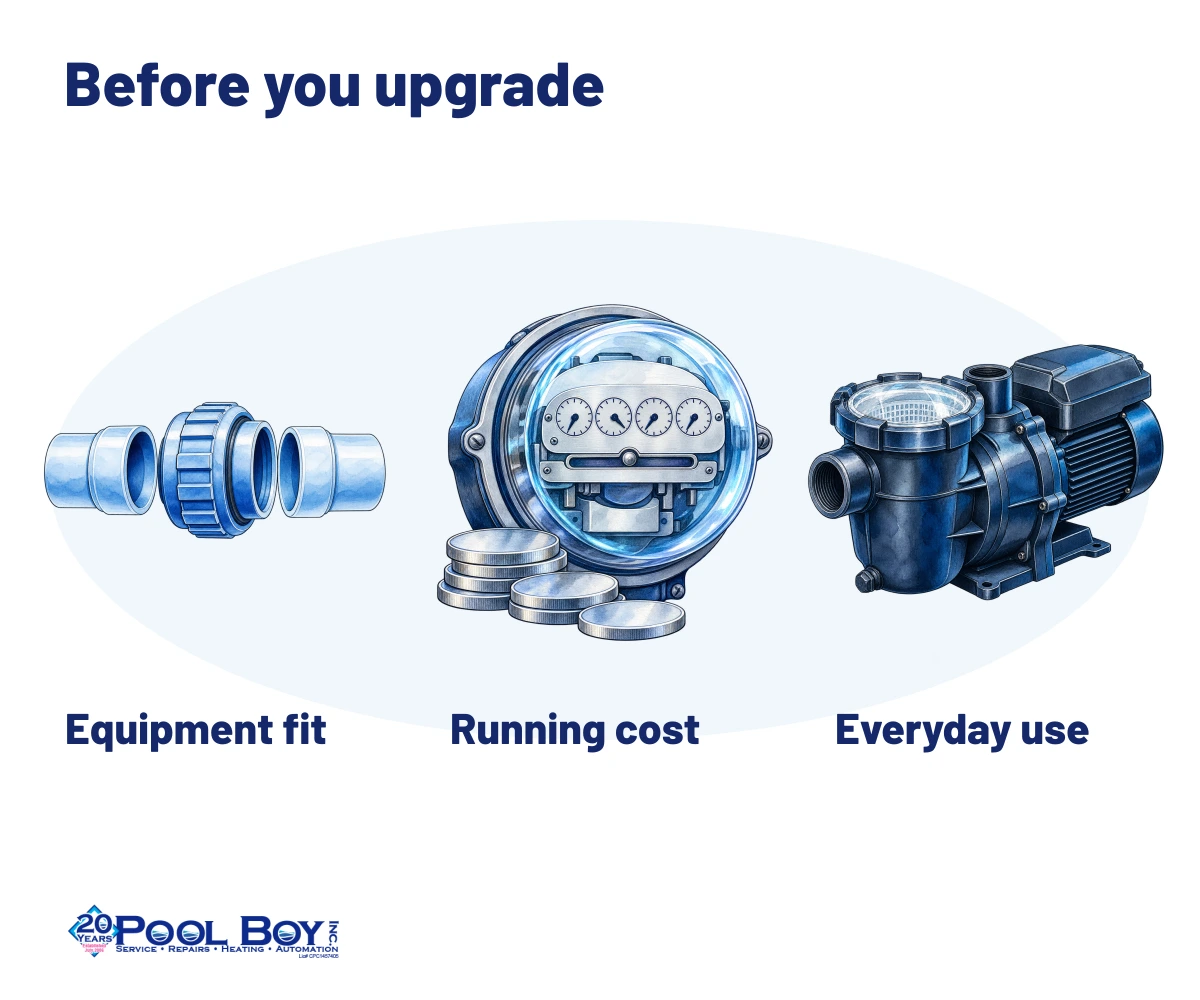
Read this graphic as text
Before you upgrade: Equipment fit · Running cost · Everyday use
Plumbing fittings represent compatibility; a meter and coins represent running cost; a circulation pump represents everyday use. Compare the equipment fit, realistic operating cost and practical improvements. No measured savings are depicted.
Questions to ask before choosing a pump
- What problem will this replacement solve for my pool?
- Is it compatible with my existing equipment and controls?
- Does the estimate include installation and programming?
- What assumptions support any projected energy savings?
- Which features will I actually be able to use?
- What will I need to understand about the new controls?
Frequently asked questions
Is a bigger pump a better upgrade?
Not automatically. The goal is a suitable match for the pool and its equipment. A horsepower number by itself does not tell you whether a pump is the right choice.
Do I need to replace a working pump immediately?
There is no single answer. Compare its condition and operating costs with the installed cost and benefits of the proposed replacement. An assessment can help you decide whether to upgrade now or plan for a later replacement.
Will a variable-speed pump eliminate regular pool care?
No. A different pump does not take over brushing, vacuuming, water testing, or the rest of the pool’s maintenance routine.
Get a recommendation for your pool
Pool Boy provides energy-efficient pool pump installation for local homeowners. If you are weighing an upgrade, tell us what you have now and what you would like to improve.
Call 941-255-1900 or request service online to discuss your pool in Punta Gorda, Port Charlotte, or Charlotte County.