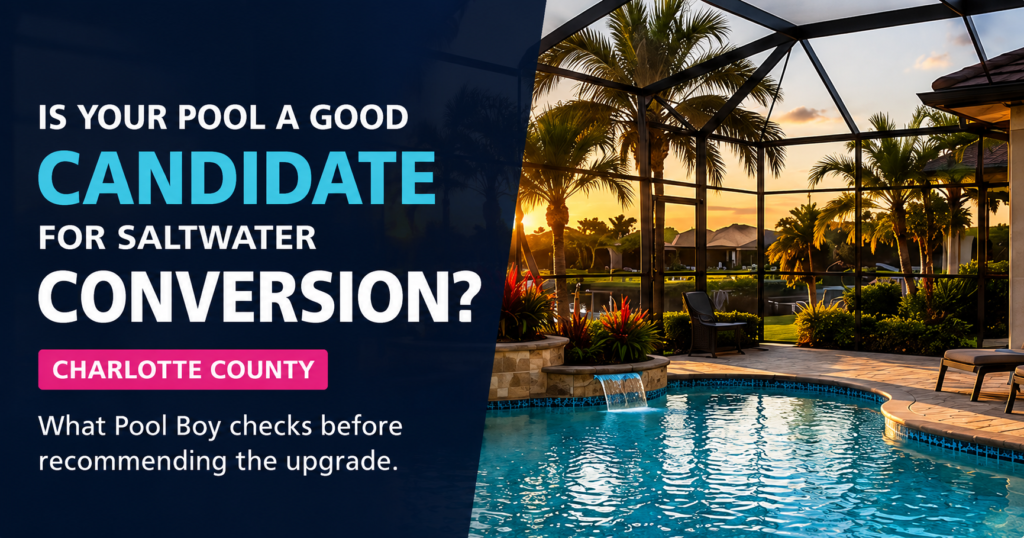
Saltwater conversion is a popular pool upgrade throughout Punta Gorda, Port Charlotte, Rotonda West, and the rest of Charlotte County—but not every pool is an automatic yes. The right recommendation depends on your pool’s condition, circulation, equipment, materials, and the way you use it.
A pool with dependable circulation, properly functioning equipment, a compatible heater, and sound surfaces is often a strong candidate for saltwater conversion. Existing problems do not always rule it out, but they should be identified and addressed before the new system is installed.
Why candidacy matters before installation
A salt chlorine generator can provide steadier sanitizing and a more comfortable swimming experience, but it cannot correct an unresolved leak, weak circulation, failing equipment, or neglected water chemistry. Evaluating those conditions first protects the investment and helps the new system perform as intended.
That is why Pool Boy begins with the pool—not the sales pitch.
6 signs your pool may be a good candidate
- You use your pool frequently and value comfortable, consistently sanitized water.
- You are tired of storing, transporting, or manually adding chlorine.
- Your pump, filter, plumbing, and circulation are working reliably.
- Your heater is compatible with a saltwater environment or can be properly protected.
- Your pool surface, rails, ladders, and other metal components are in reasonable condition.
- You want a system that can produce chlorine steadily while the circulation system runs.
Several checked boxes usually mean the pool is worth evaluating. A professional inspection confirms the details that cannot be determined from the waterline alone.
What Pool Boy checks before recommending conversion
Circulation and equipment
We review the pump, filter, valves, plumbing flow, equipment condition, and available space for the salt cell.
Heater compatibility
We identify the heater and heat-exchanger material, review its condition, and explain any precautions or upgrades that may be appropriate.
Surfaces and metals
We inspect the pool finish, rails, ladders, nearby metal hardware, bonding, and other areas that deserve protection from poor chemistry or corrosion.
Electrical and controls
We determine how the generator will be powered and whether it can be integrated correctly with existing timers, automation, and safety controls.
Finding an issue does not always mean “no.” It may simply mean repairing a leak, improving circulation, replacing an aging component, or correcting water chemistry before moving ahead.
What happens during a saltwater conversion?
In most standard conversions, the existing pool water remains in place.
✓ No routine draining required- Evaluate the pool and equipment. We confirm candidacy, calculate pool volume, and select an appropriately sized system.
- Test and balance the water. Starting chemistry matters because a salt system works best when the water is already properly balanced.
- Install the generator and cell. The cell is plumbed into the equipment system and the controls are connected correctly.
- Add pool-grade salt. Salt is added according to the pool volume and the manufacturer’s required operating range.
- Start, test, and calibrate. We confirm flow, chlorine production, operating settings, and system communication before completing the installation.
We also explain what the system does, what it does not do, and what ongoing care it will require. For a plain-English explanation of the technology, read how saltwater pools actually work.
What affects saltwater conversion cost?
There is no responsible one-price-fits-all answer. The total depends on the pool and the equipment already in place. The largest cost factors typically include:
The salt cell is also a wear component. Its service life varies with run time, output settings, water chemistry, cleaning practices, and manufacturer specifications. Pool Boy provides the equipment recommendation and project-specific pricing before work begins.
Why Charlotte County pools need a local evaluation
Southwest Florida creates demanding operating conditions. Strong ultraviolet exposure consumes chlorine quickly, heavy rain changes water balance, warm water supports faster algae growth, and year-round pool use can increase sanitizer demand.
A correctly sized salt system can help produce chlorine more consistently, but it still requires proper stabilizer, pH control, circulation, testing, and routine service. Saltwater is not chlorine-free or maintenance-free. It is a different—and often more consistent—way to sanitize the pool.
For a balanced look at comfort, maintenance, and ownership expectations, see the real benefits of a saltwater pool.
Why professional installation matters
A conversion involves more than connecting a box. Proper sizing, hydraulic flow, electrical installation, control integration, equipment protection, and startup chemistry all affect performance and longevity. Professional evaluation also prevents a new salt system from masking—or being blamed for—an existing pool problem.
Pool Boy services more than 1,500 pools each week and provides equipment installation, repair support, GPS-tracked service, and no-contract pool care throughout the area. That means the same local team can evaluate the pool, install the system, and support it after startup.
Find out whether your pool is ready
The best next step is a pool-specific evaluation. Pool Boy will review the equipment, identify any concerns, explain the available options, and provide an honest recommendation based on the pool you actually own.
Is your pool a good candidate?
Call Pool Boy Inc. for a saltwater conversion evaluation in Charlotte County.
Call 941-255-1900 Free, no-obligation evaluationFrequently asked questions
Can every swimming pool be converted to saltwater?
Many residential pools can be converted, but equipment condition, circulation, heater compatibility, surfaces, metal components, plumbing, and electrical setup should be reviewed first. Some pools need repairs or upgrades before conversion.
Does saltwater conversion require draining the pool?
Routine conversion generally does not require draining the pool. The existing water is tested and balanced, the system is installed, and pool-grade salt is added to the required operating level. Unusual water or repair conditions may change that recommendation.
Will a saltwater system damage my heater or screen enclosure?
A properly installed and maintained system should account for the heater, bonding, metals, and surrounding equipment. Poor water chemistry and incompatible or deteriorating components increase risk, which is why Pool Boy inspects them before recommending conversion.
How much does saltwater conversion cost in Charlotte County?
Cost depends on pool volume, the generator selected, equipment-pad and electrical requirements, automation compatibility, and whether repairs or upgrades are needed first. A pool-specific evaluation is the most accurate way to price the project.
How long does a salt cell last?
A salt cell commonly lasts several years, but actual service life varies by manufacturer, run time, chlorine-output setting, water chemistry, cleaning practices, and pool demand. It is a normal replacement component of a saltwater system.