If you’ve ever stepped into your pool and felt your eyes sting—or had to wait after adding chemicals before swimming—you’re not alone. Traditional chlorine pools can come with noticeable highs and lows, from strong chemical smells to inconsistent water balance.
That’s where salt water pool conversion in Punta Gorda, Port Charlotte, and North Port enters the conversation—not as a shortcut or a maintenance-free solution, but as a different way to produce and manage chlorine.
What is a salt water pool?
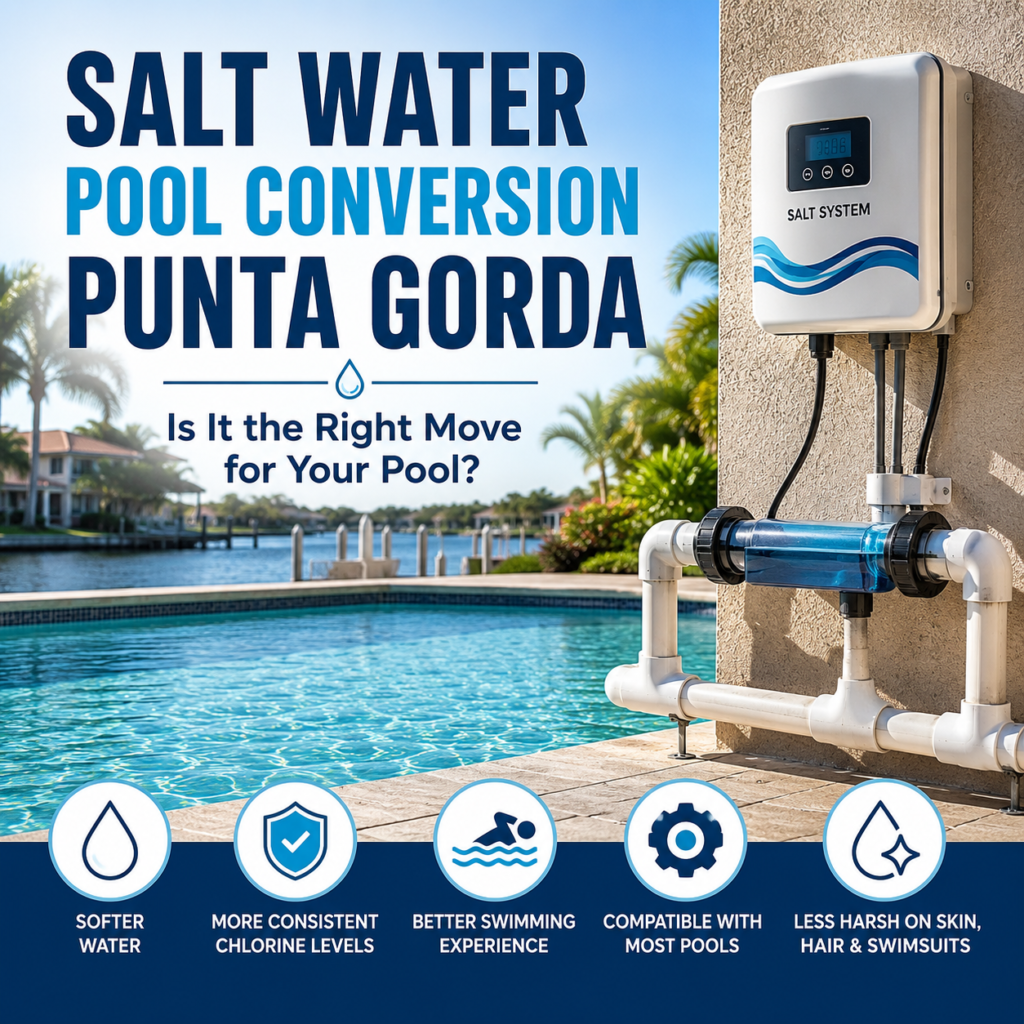
A salt water pool is not chlorine-free. It uses a salt chlorine generator to make chlorine automatically from a small amount of dissolved salt rather than relying entirely on chlorine that is manually added to the pool.
Pool-grade salt dissolves into the water at a level far below ocean water.
The system uses electrolysis to convert dissolved salt into chlorine.
The generator produces chlorine while the pool system is running.
This creates a more controlled and consistent method of maintaining sanitized pool water.
Salt water vs. traditional chlorine pools
The biggest difference is not whether chlorine is present. The difference is how the chlorine is delivered.
Traditional chlorine pool
- Chlorine is added manually
- Levels may spike after treatment
- Levels may fall before the next treatment
- Water chemistry can feel less consistent
Salt water pool
- Chlorine is generated automatically
- Production occurs while the pump runs
- Chlorine delivery is generally steadier
- Water quality may feel more consistent
The key takeaway: A salt water pool is still a chlorine pool. The swimming experience changes because the chlorine is produced steadily—not because chlorine has been removed.
Benefits of salt water pool conversion in Punta Gorda
In Southwest Florida, where many pools are used throughout the year, comfort and consistency can matter just as much as appearance.
Many swimmers describe salt water as gentler and more comfortable on their skin and eyes.
Steady production can reduce some of the dramatic highs and lows associated with hand-dosing.
Many homeowners notice less of the strong chemical smell associated with poorly balanced water.
Homeowners who swim often may appreciate water that feels more stable from day to day.
For many Punta Gorda, Port Charlotte, and North Port homeowners, the appeal is not doing less work. It is enjoying better and more consistent water.
Are salt water pools easier to maintain?
Salt water pools are not maintenance-free. They are maintained differently. Water chemistry, equipment performance, circulation, salt levels, stabilizer, pH, and the salt cell still require routine attention.
The salt system helps produce chlorine more consistently, but it does not remove the need for regular testing, balancing, cleaning, inspection, or professional service.
Pool Boy recommends salt systems when they can improve the homeowner’s overall pool and swimming experience—not because they are supposedly maintenance-free.
Can an existing chlorine pool be converted?
Many existing chlorine pools can be converted, but not every pool should be converted without first evaluating the entire system.
- Existing equipment compatibility
- Pool size and total water volume
- Condition of the pump, filter, plumbing, and electrical system
- Heater compatibility
- Pool surface materials
- Metal rails, ladders, and fixtures
- Existing leaks, circulation problems, or unresolved repairs
Some pools may need repairs, upgraded equipment, or additional protective measures before a salt system should be installed. That is why the evaluation—not the installation—is the most important first step.
Is salt water conversion right for your pool?
It may be a good fit if:
- You want steadier chlorine production
- You are bothered by strong chemical smells or irritation
- You want softer-feeling water
- Your pool is used frequently
- Your equipment is compatible and in good condition
It may be better to wait if:
- Your pool has unresolved leaks or circulation problems
- Your heater or equipment is not compatible
- Your pool surface or metal components need attention
- Repairs should be completed first
- The conversion would not meaningfully improve your experience
Why a professional evaluation matters
A proper salt system installation involves more than adding a salt cell. Every component needs to work together correctly and safely.
During an evaluation, Pool Boy considers:
- The condition and compatibility of existing equipment
- The overall health of the pool and circulation system
- Pool size and the correct generator capacity
- Heater, surface, plumbing, electrical, and metal components
- Whether conversion would genuinely benefit the pool
Get a free salt water pool conversion evaluation
Pool Boy will inspect your current system, answer your questions, and help determine whether a salt system is a good fit for your pool.
Call 941-255-1900Serving Punta Gorda, Port Charlotte, North Port, and surrounding Southwest Florida communities.