
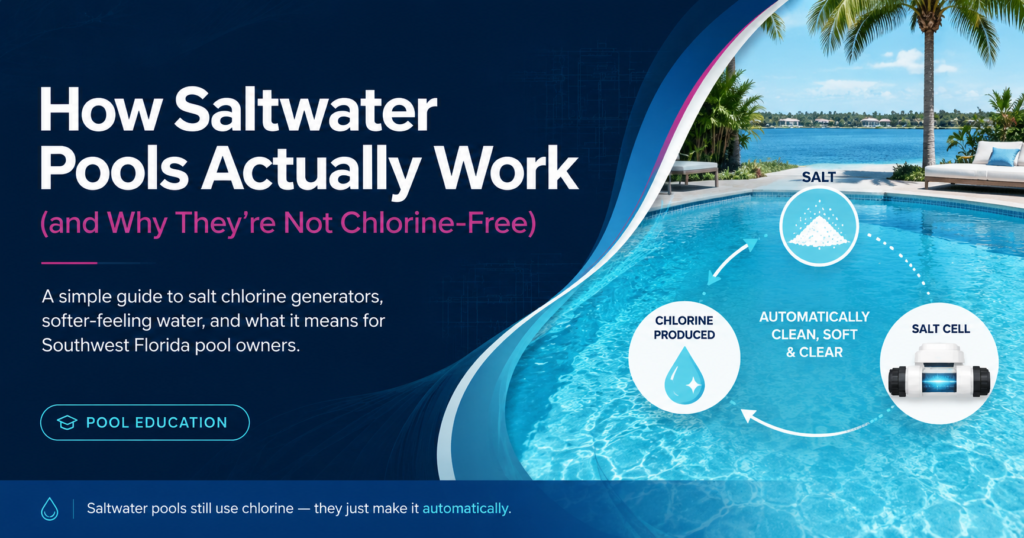
If you’ve swum in a friend’s saltwater pool here in Southwest Florida and thought, “the water just feels nicer,” you’re not imagining it. But there’s a myth worth clearing up before you go any further: a saltwater pool is not a chlorine-free pool. It’s actually one of the smartest ways to keep chlorine in your water consistently — which, in Charlotte County’s sun, matters more than most people realize.
Let’s walk through how it really works, in plain English.
The one-sentence version
A saltwater pool uses a small device called a salt chlorine generator to turn a little bit of dissolved salt into chlorine automatically — so instead of pouring in chlorine by hand, your pool makes a steady supply on its own.
That’s the whole idea. Everything below is just the “how.”
What a salt chlorine generator actually does
A salt chlorine generator (you’ll also hear “salt cell” or “SWG”) installs on your pool’s equipment pad, inline with the plumbing you already have. You add pool-grade salt to the water, and as that salty water flows through the cell, a low electrical charge splits the salt into chlorine through a process called electrolysis.
The salt cell: where the magic happens
Inside the cell are specially coated metal plates. When water passes over them and the system is running, they convert salt into chlorine right there in the pipe. That chlorine sanitizes your pool exactly like it always has — then, remarkably, it recombines back into salt. The same salt gets reused over and over, which is why you only top it off a few times a year rather than constantly.
Why the salt level is so low you won’t taste it
People hear “saltwater” and picture the Gulf. In reality, a saltwater pool runs at roughly one-tenth the saltiness of ocean water. Most swimmers can’t taste it at all — the water just feels a little softer and silkier than a heavily hand-chlorinated pool.
So… is a saltwater pool chlorine-free? (No — and that’s a good thing)
This is the big one. Saltwater pools still use chlorine — the chlorine is simply generated on site instead of added from a bucket or tablet. Why is that good? Because chlorine is what keeps the water safe to swim in. What changes is the delivery: steady and automatic instead of manual and up-and-down. Many homeowners notice less of that harsh “chlorine smell,” too — which often comes from chemistry swings in a hand-dosed pool rather than from chlorine itself.
Saltwater vs. traditional chlorine: what’s really different
With a traditional pool, you (or your service tech) add chlorine products regularly, and levels can spike after a fresh dose and dip before the next one. With a salt system, the generator makes chlorine whenever the pump runs, aiming for a steadier level day to day. You’ll still test and balance the water — but you’re managing a system rather than chasing a moving target with buckets. (If you’re weighing it up, here are the real benefits and honest expectations.)
What this means for a pool in Charlotte County’s sun and rain
Here’s where Southwest Florida changes the conversation. Our UV index regularly hits extreme levels in summer, and unprotected chlorine can burn off in just a few hours of direct sun. That’s why consistent chlorine production is genuinely useful here — a salt system quietly keeps making chlorine while the sun is doing its best to destroy it. Rainy season adds its own swings, diluting your water with every storm. A steady generator won’t eliminate those realities, but it helps your pool keep up with them.
What still needs attention (the honest part)
We’ll never tell you a saltwater pool is maintenance-free, because it isn’t. You (or your pool company) still watch pH, alkalinity, stabilizer, and salt levels, and the salt cell itself is a wear item that’s typically replaced every few years. Salt systems also tend to nudge pH upward, so that gets a closer eye. In short: less hand-dosing, but not zero care — especially in a climate that changes water chemistry as fast as ours.
Is a salt system right for your pool?
Not every pool is an automatic yes. Your heater, metal fixtures, surface, plumbing, and electrical all factor into whether conversion makes sense and what (if anything) should be addressed first. That’s exactly the kind of thing worth having a local pro look at before you decide.
Talk to a local pool company that does this every day
Pool Boy Inc. services more than 1,600 pools every week across Punta Gorda, Port Charlotte, and the surrounding Charlotte County communities — so salt systems are routine for our team. If you’re curious whether your pool is a good fit, we’re glad to take a look.
Curious if your pool could run on a salt system?
Call Pool Boy Inc. to find out whether your pool is a good candidate for saltwater conversion.
Call 941-255-1900Frequently asked questions
Are saltwater pools chlorine-free?
No. Saltwater pools are sanitized by chlorine, but the chlorine is generated on site by a salt chlorine generator instead of being added by hand. The salt is converted into chlorine, which cleans the water and then recombines back into salt.
Will a saltwater pool taste salty?
Usually not. Pool salinity is about one-tenth that of ocean water, so most swimmers can’t taste it — the water simply feels softer.
Do saltwater pools still need maintenance?
Yes. They require less hand-dosing of chlorine, but pH, alkalinity, stabilizer, salt levels, and the salt cell still need regular attention — especially in Florida’s climate.
Is a salt system good for Florida’s sun?
It can help. Because intense UV burns off chlorine quickly here, a salt system’s steady chlorine production is useful, though stabilizer and balancing are still required.